

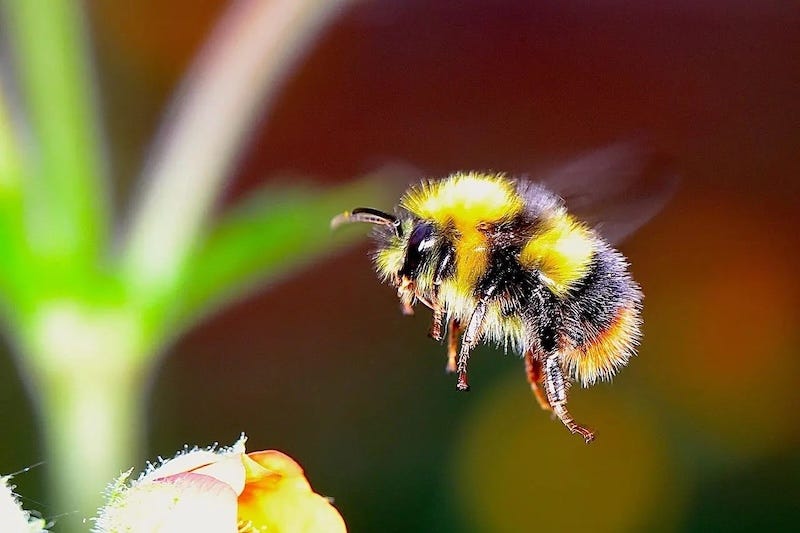
As it reaches 50 degrees, our buzzing friends are emerging from their hives and commence their work. I am referring to bees, not their mean hornet and wasp cousins (who are not bees); but the sweet honeybees and bumblebees that hover around our landscapes. There are over 20,000 species of bees who pollinate a third of the food that we eat.
Right now, many bees are still safe in their hives, away from the cold, devouring honey that they produced last year. But soon they will be among us.
Most know that bees are impressive creatures. In turns out they are also very smart.
Bumblebees can be trained to do simple tasks to get to a favorite treat (sugary water). They can move, not one, but two separate levers to get their reward, the first lever is needed before the second lever can move. Bumblebees also like to play. In a laboratory, scientists allowed them to choose a small bead to play with or food, and many chose to play with the bead.
Honeybees can recognize and remember human faces for at least two days and sometimes up to a month. They use scent, color, and visual cues to distinguish between people, often becoming accustomed to a familiar, calm beekeeper.
Hives work as a single organism. Worker bees, who are all female, have a number of responsibilities depending on their maturity. When they first hatch, their job is to feed the young. When they become more experienced, they serve as guardians of the hive or venture from the hive to gather nectar and pollen. Other worker bees build the elaborate and sturdy honeycombs that will be used to raise their young and store honey. The pollinator worker bees produce honey from nectar. It takes 2 million flowers to make a single pound of honey.
Bees are critical for human survival. For example, to produce almonds in California (the primary supplier of almonds in the world), 30 billion bees are trucked to California for a 7-day flowering of the trees. Without these bees, there would be no California almonds.
A healthy, mature hive typically houses between 30,000 and 60,000 bees during the summer, though it can peak as high as 80,000 or more. The population fluctuates significantly, dropping to roughly 5,000 to 10,000 bees during the winter as the colony downsizes to survive.
Bees use both pollen and nectar, but for different purposes. Nectar is used to make honey, while pollen is essential for protein, nutrients, and feeding larvae. Pollen is packed into cells as “bee bread” to feed young bees and support the queen.
Worker bees feed the larvae and within a week the babies have grown 1,000 times bigger and are tucked into the cells to transform into bees.
The most revered bee is, of course, the queen bee. There is a single queen in each hive who lays 2,000 eggs daily. A queen bee can live for five years doing nothing but laying eggs.
Male bees, called drones, are only for mating with queens from other hives. They cannot feed themselves, and are no longer welcome in the hive after procreation season.
When the queen relocates, she will leave the hive with half of the bees. Scout bees then find their next location. After the queen leaves, the workers feed several new queens. The first queen to emerge and mate with drones from other hives becomes the new queen. (She can mate with up to 20 different drones from different hives.)
Bees communicate via the “waggle dance.” They use this to tell other bees where to get nectar and pollen. Scouts do the “waggle dance” to notify other workers and the new queen where to build their next hive.
There is a downside to some bees, wasps and hornets. Some of them sting (most indigenous species do not sting), and many people have allergies to bee stings. Like 10% of the population, I experience a large local reaction from a honeybee, wasp or hornet sting (which is swelling of more than 2 inches). Life-threatening anaphylactic reactions cause 60–100 deaths annually in the U.S., most are from wasps and hornets. These serious reactions are relatively rare, with lower rates in children. Fear of bee stings is more common than actual allergies (a sting hurts!!!).
Growing up on a farm, I was used to bee hives and never developed a fear of them. (My sisters accused me of deliberately getting stung to get out of work.) Unlike wasps and hornets, honeybees and bumblebees only sting when threatened (or, in my case, stepped on!).
So pretty soon, we will welcome these remarkable insects. We need to just stay clear of them and so they can do their life-giving work.